

Wading through the crowded lanes and going through the now ever present security checks (mobiles, electronic gadgets, bags are not allowed in the temple, they can be deposited outside in the shops), I began my climb of the 30 odd stairs leading to the Temple courtyard.

[ Crowded lane leading to the Brahma Temple ]
The history of this sacred place is illustrated in the Holy Hindu Scripture Padma Purana…
Lord Brahma killed the demon Vajranabh by throwing on him His weapon ‘The Lotus Flower’. In the process of killing him, the petals of the Lotus fell at three places (in Pushkar itself) where beautiful lakes sprang up from the impact. Thus, Lord Brahma named this place as ‘Pushkar’ (‘Pushpa’ meaning flower had fallen from ‘Kar’meaning hand).
He then decided to perform a Yagna (fire-sacrifice) at the main Pushkar Lake. The completion of this Yagna required the presence of His wife, Goddess Savitri. As the auspicious time was running out and Goddess Savitri was nowhere to be seen, Lord Brahma married Gayatri and completed the Yagna with Her by the side. When Goddess Savitri arrived and saw Gayatri sitting in place of Her, she became so annoyed with Lord Brahma that she cursed Him and later went to reside on the nearby Ratangiri hills. It is believed that it’s the result of that curse that today, Lord Brahma is worshipped only at this place in the whole world.
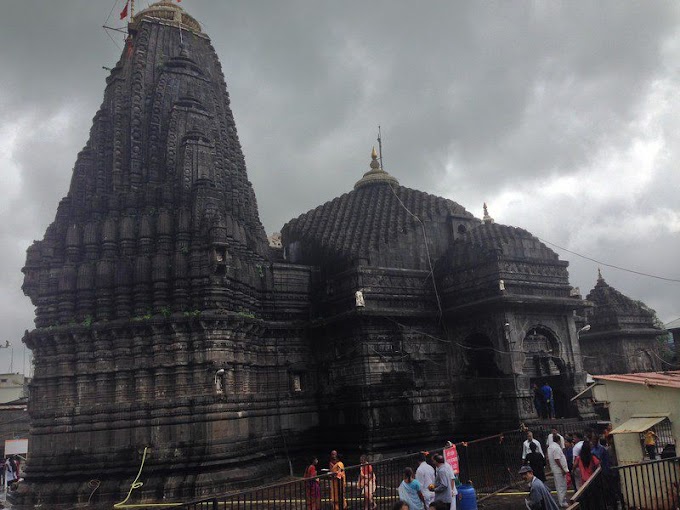
The Lord Brahma Temple (Jagat Pita Brahma Mandir), close to the Pushkar lake and believed to be over 2500 years old, stands on a lofty plinth with marble steps leading up to a beautifully arched entrance gateway which is adorned with a distinct motif of a swan, the vehicle of Lord Brahma.

[ The steps leading up to the Lord Brahma Temple ]
This gateway led me into the intricately carved pillared outdoor hall. The pillars are a medley of bright blue, green and golden colors complemented perfectly by the bright red shikhar (spire). The whole temple looked stunning, almost radiating light from the various different colors! In addition to this, the chessboard marble flooring done in black and white marbles, the small silver turtle sitting pretty on the floor facing the sanctum and the silver coins engraved with the names of devotees inlaid in the walls and the flooring of the temple…all of these added a unique distinctness to the temple!!
Finally, I moved towards the central sanctum sanctorum…Having read and heard so much about it in history, the only Brahma temple I have ever been to… here I was, standing in front of the four faced (chau murti) life size idol of Lord Brahma… eyes closed and head bent… my moment of spiritual bliss… Flanked by Goddess Gayatri to his left and Goddess Savitri to his right, He was draped in silk cloth and covered with fresh flowers and colorful garlands.
As I circumambulated the temple, I visited the other smaller temples of Lord Indra, Lord Kubera and Lord Shiva (which is located underground in a small cave) which are present inside the temple complex before resting for a few minutes in the courtyard.
I could not help but wonder that in a religious country like India where hundreds of thousands of shrines are found dedicated to various Gods and Goddesses and even Saints, Lord Brahma has remained conspicuous by His absence. Whatever the reason, I believe that it has only added to the value, beauty, charm and mystic of the place called Pushkar…


24 Comments
Very informative and interesting!!
ReplyDeleteArti,
ReplyDeleteThat is again a good post.Though it is being said that Brahma is not worshipped in idol form in any temple, I already visited two temples here in TN.I heard about one more temple which is very famous near here and I am planning a trip soon. So shall post about that. May be these were all later additions.
I wish they would have let you take pictures of the inside. But then again, if you could, it probably wouldn't be very sacred, would it? The steps look very steep!! Were they, or is that just the angle of the picture? Tried to see the swan, but can't find it! The first picture is a good shot of the ladies in their colorful clothing. What did you wear, anything like this?
ReplyDeleteIt was very nice to learn about the history of the place and the temple.I have always loved all mythology!!
ReplyDeleteUS Masala
A beautiful and divine post!
ReplyDeleteHappy Weekend, dear Arti :-)
ur description of pushkar bhamha temple is so interesting .. ... but do u know there is a brahma temple near trichy where there are some 12 siva lingas which bhahma worshiped for some atonement... it is a very old temple in south india .. it also has the jeeva samadhi of patanjali which i did not know until i found this link
ReplyDeletehttp://rammesh.kaaninilam.com/tlogs/brahma/index.htm
Satya
http://www.superyummyrecipes.com
http://shanthiraju.wordpress.com/2007/11/26/visit-to-trichy-and-tanjore-temples/
ReplyDeletevery interesting link of all temples near trichy with more details of the bramha temple
Dear Arti
ReplyDeleteLoved the posting ...last time I visited Puskar was in 1992 or so...Time to go again. I understand , the lake had dried up last year but now it is full.,
Absence of Brahma is mysterious. There are many theories. The one I like and was told by an young Sadhu at Badrinath is like this " The learned ancient Munis and sages used to wonder and think what is beyond earth that we see, what is Brhamanda and what is beyond every thing one can imagine ...knowing this, is called "Brahma-gyan" . ( Now the modern science is trying to know). Brahma is the creator of, not only earth but the universe and beyond. Now you will see all our Gods and Goddesses ( except Brahma) are associated with our earthly requirements, we pray to them to get some thing materialistic and earthly ( like good health, good rain , good crop, defend from enemy, good education etc etc). Accordingly temples were made for different Gods to pray for our requirements...and the common man didnot have any thing to pray from Brhma and didn't have a reason to build a temple. He remained with the explorers, the learned ones, of the Brahma gyan.
I have forgotten how a Brahma temple came up in Pushkar. I understand at Manosarovar Brahma is worshiped, and represented by swan...need to read more.
This is one explanation which I find logical ...there are stories on Brahma to contradict this theory...you find out
Thank you once again for hosting this wonderful site.
Have a nice weekend
I enjoyed this, and as always loved your photos. Thanks for sharing this.
ReplyDeleteAll the best, Boonie
I had posted a comment here. Not sure whether it got registered. Arti, please check.
ReplyDeleteIt was nice to know one more temple, thanks for sharing arti..
ReplyDelete@chitra
ReplyDeleteThanks and your comment did register, just a bit of delay from my side.
I too have heard of some Brahma temples in TN and
will surely wait for your posts...
@Ginny
ReplyDeleteThe stairs are not at all steep. The swan, I see, is not visible in the picture! It is a little on the inner side of the gate.
I like to wear our traditional dresses, they are indeed very colorful!
@Satya
ReplyDeleteThanks for those links, Satya...
Just checked them out... The blogs are interesting and very beautiful!
@Ushnish Ghosh
ReplyDeleteI have heard a lot of stories too..
But this one as you have pointed out is logical as well..
Also, since He is the creator of our ancient scriptures- the Vedas.. I guess the best way to worship Him might be to try and imbibe the values and always choosing the 'right' path in life.
Thanks for your wonderful comment and encouragement:)
So refreshing to hear that mobile phones are not allowed. An interesting and informative post, thank you.
ReplyDeleteDear Arti,
ReplyDeletethanks a ton for your encouraging comment and for the good wishes. It means a lot to me :-)
Wonderful to know the history of the place. I had heard about this temple before, but never ever seen the images of the place before.
ReplyDeleteYour blog is nice and informative.
ReplyDeletehttp://shanthisthaligai.blogspot.com/
nice post about Lord Brahma's temple. Though I know that Lord Brahmah doesn't have temples due to some reason, i never knew the reason. Today i came to know about the true reason after reading yours. A good effort as usual on your side.
ReplyDeleteHave been meaning to visit Pushkar for a long time now... thanks to you, I saw it through your eyes :) fantastic post!
ReplyDeletehmm, one of the very few places to have a temple for Brahma
ReplyDeletenice post , great information.
ReplyDeleteTHANKS I AM SOUTH INDIAN... I CANT VISIT NORTH SO THANKS FOR BRINGING IT TO THE SOUTH..
ReplyDeleteREGARDS
GONZALEZ
http://funny-indian-pics.blogspot.com/
Delighted you stopped by... Your suggestions, feedback are really appreciated. Thanks a lot :) Hope you visit again!
If you have asked a question, please give me at least 2 days to reply back. Thank you :)